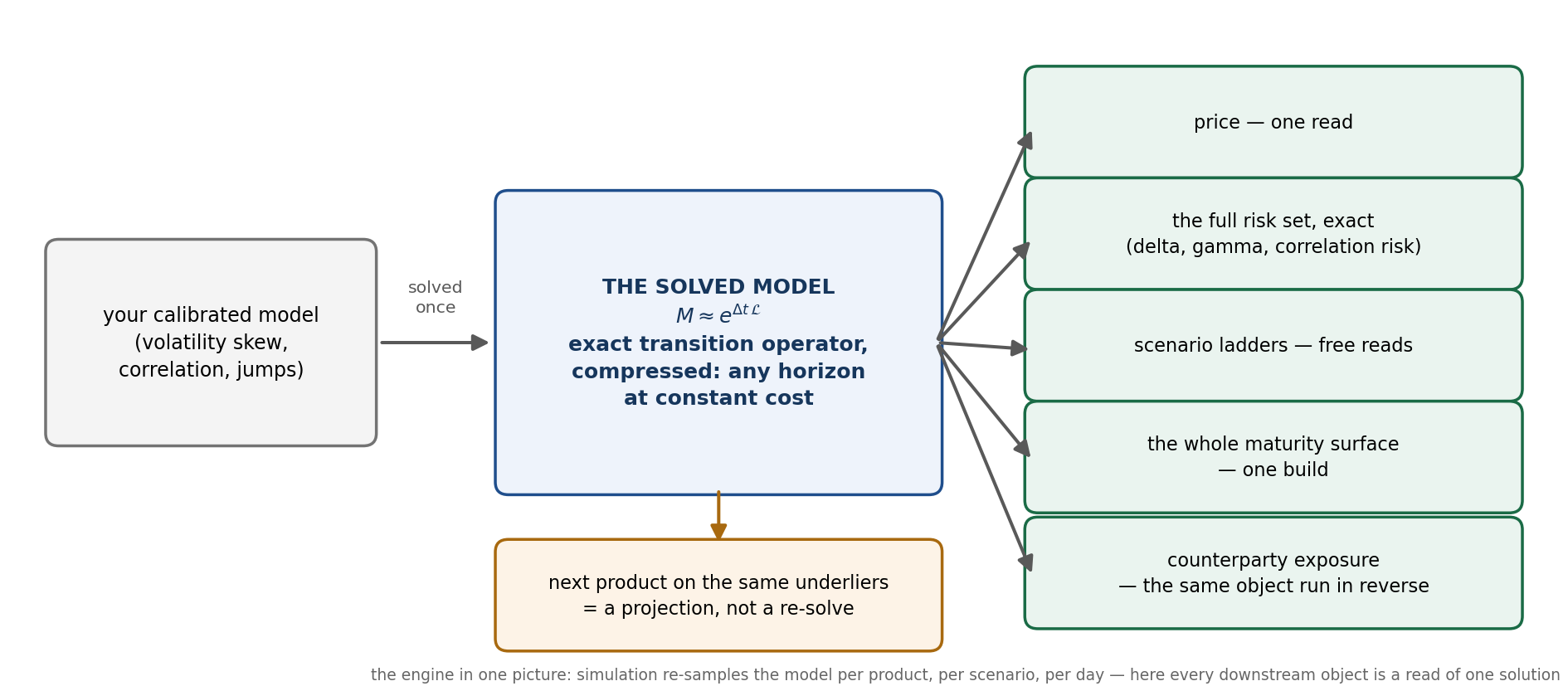
Krylo is a pricing and risk engine for the structured products that keep blowing up desks — autocallables, worst-of and knock-in books. It reads risk exactly where today’s tools go blind, delivers a full-book risk pack hundreds of times faster, and runs entirely on hardware inside your own perimeter. The idea underneath is simple: solve the model once, then read every price, Greek, scenario and exposure off that one solved object.
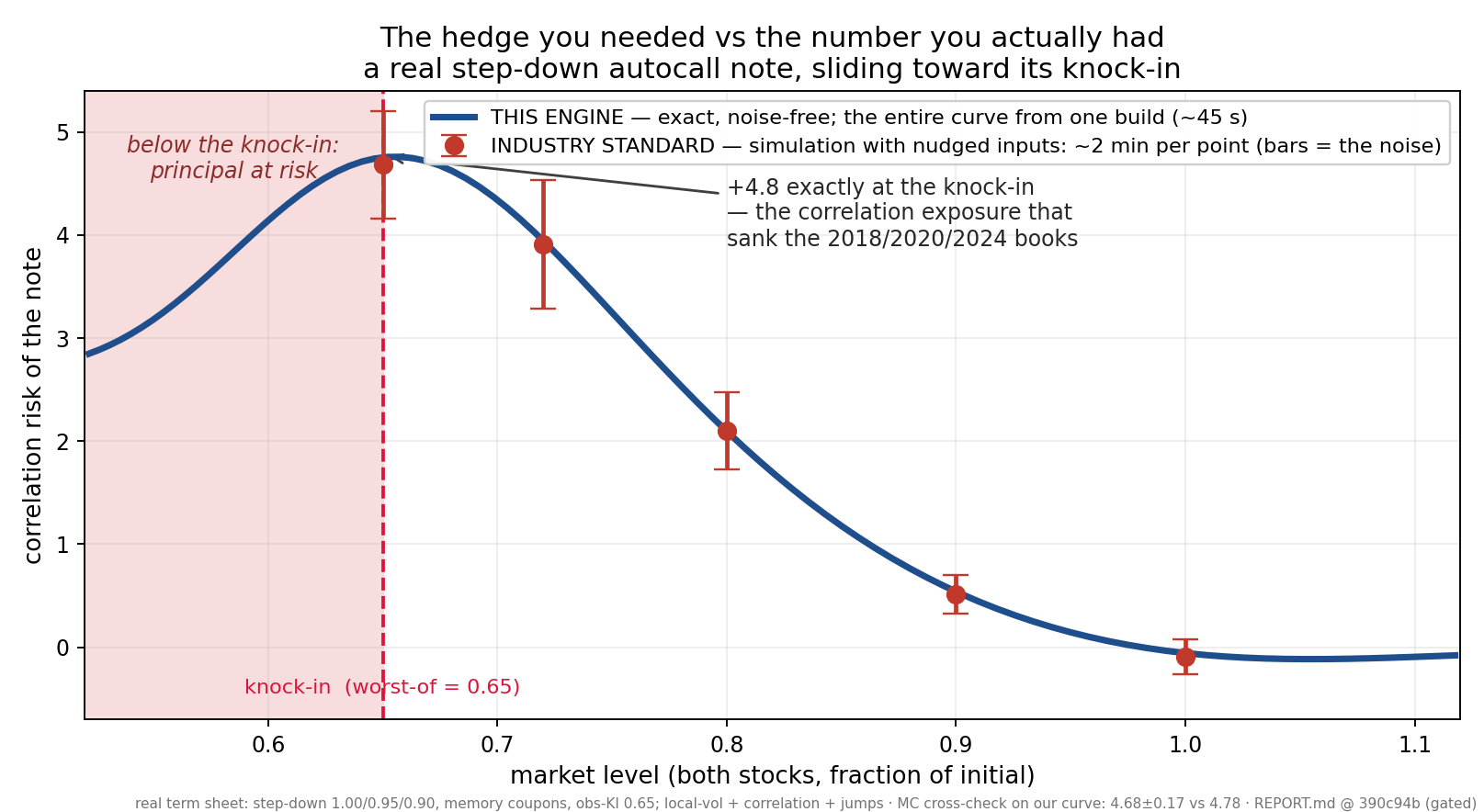
Worst-of and knock-in books broke their holders three times in six years — and the failure point is the same every cycle. The industry risk-manages these products by re-simulating them, and simulation-based risk numbers are at their noisiest exactly at the loss events: second differences across a payoff discontinuity amplify Monte-Carlo noise catastrophically. On a representative book of eight step-down notes, the industry-standard estimate of correlation risk came out at −0.06 ± 0.06 — the sign is unreadable on half the book, on the day it matters most.
The technical detail is below and in the brief. In business terms, a pilot puts three capabilities on the desk that a simulation stack structurally cannot.
The correlation and knock-in numbers that go unreadable on a simulation desk — noise swamping the signal on the exact day a book breaks — come out here as a clean, exact profile you can actually hedge on.
Daily marks, breach profiles and counterparty exposure for the whole book inside the risk window — hundreds of times less compute than a Monte-Carlo farm. No new data centre, no overnight batch that misses the morning meeting.
It sits beside your existing stack as a check on the dealer’s marks — nothing ripped out — and every number reproduces from a gated benchmark your model-risk team can rerun, not just read.
For the quants: Monte-Carlo samples the transition operator one random path at a time, and finite differences re-step through it per product and per scenario — neither ever builds the reusable object itself. Krylo does. Three components matter.
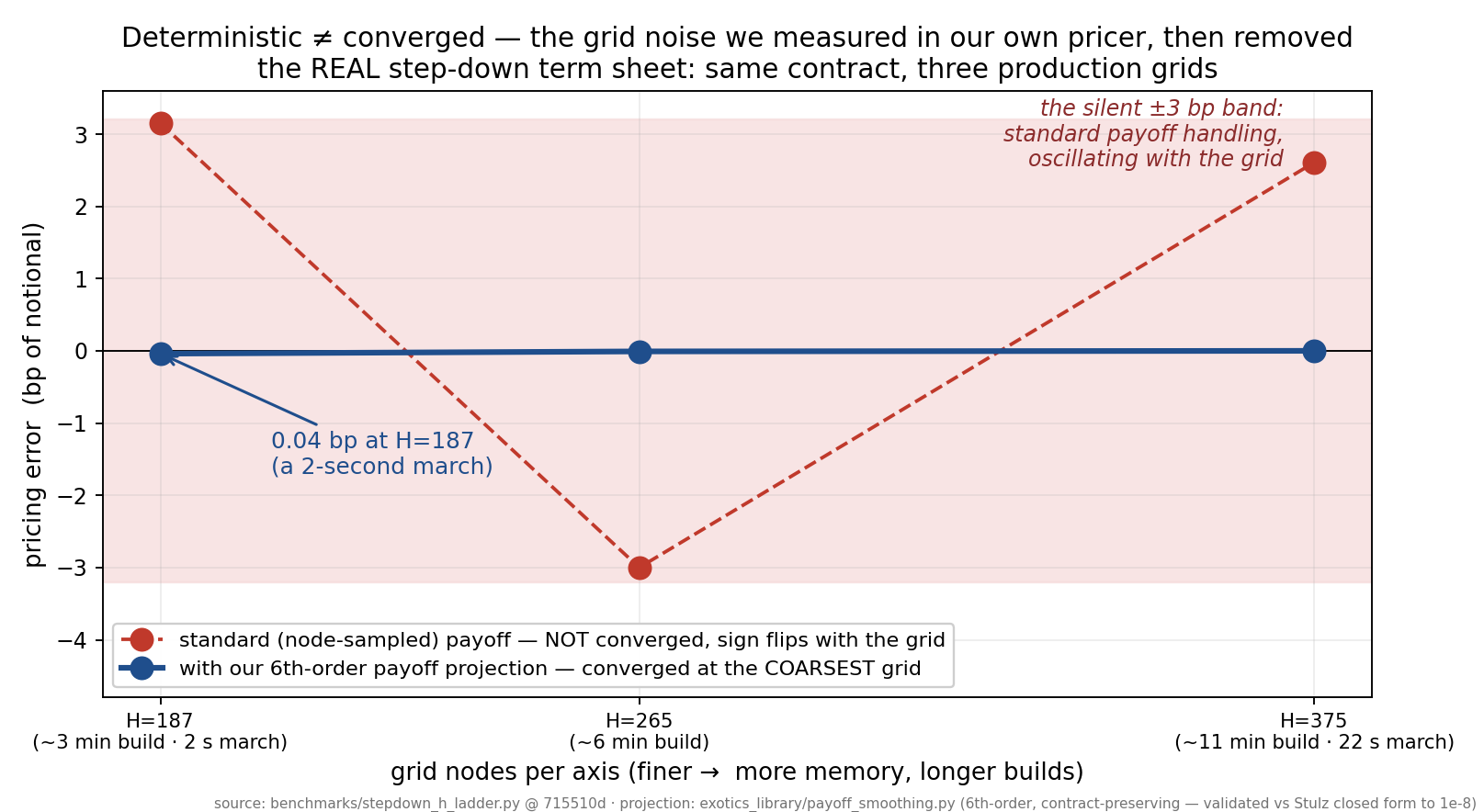
The short-time transition kernel is evaluated in closed form and moment-corrected to sixth order in space — with the correlation cross-term handled exactly, the term that forces operator-splitting compromises in ADI schemes. A one-year horizon is a handful of large, high-order steps.
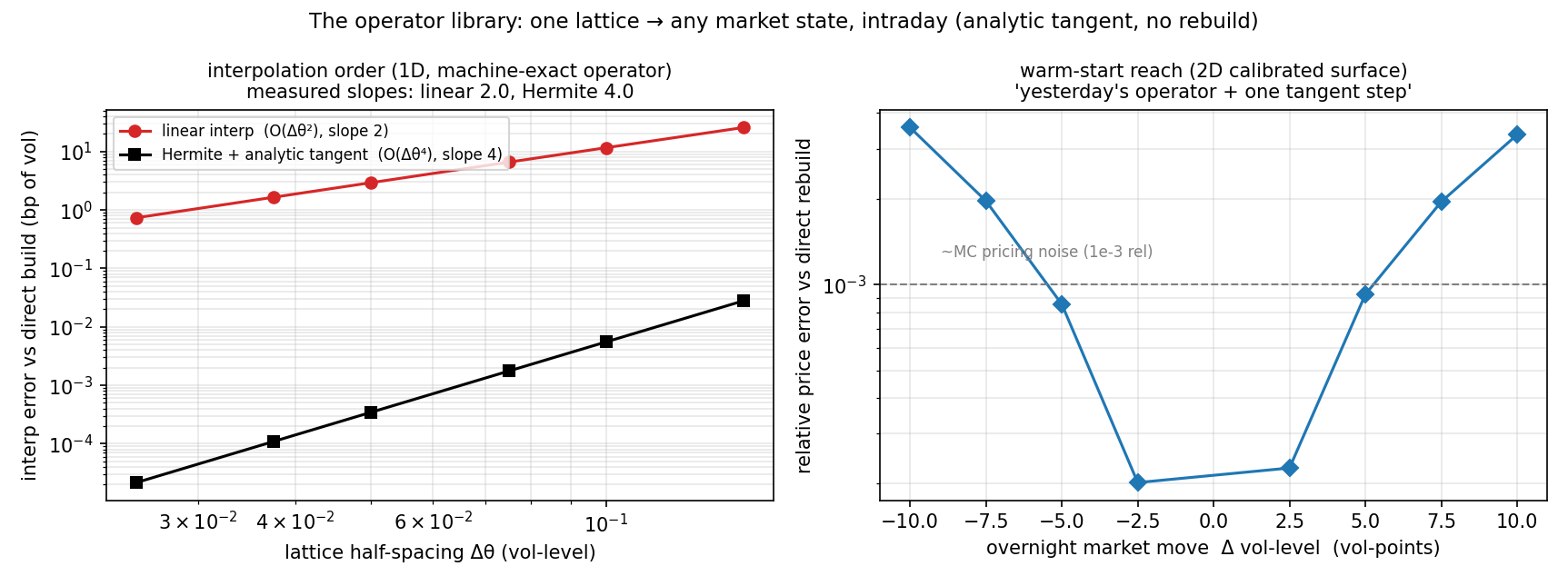
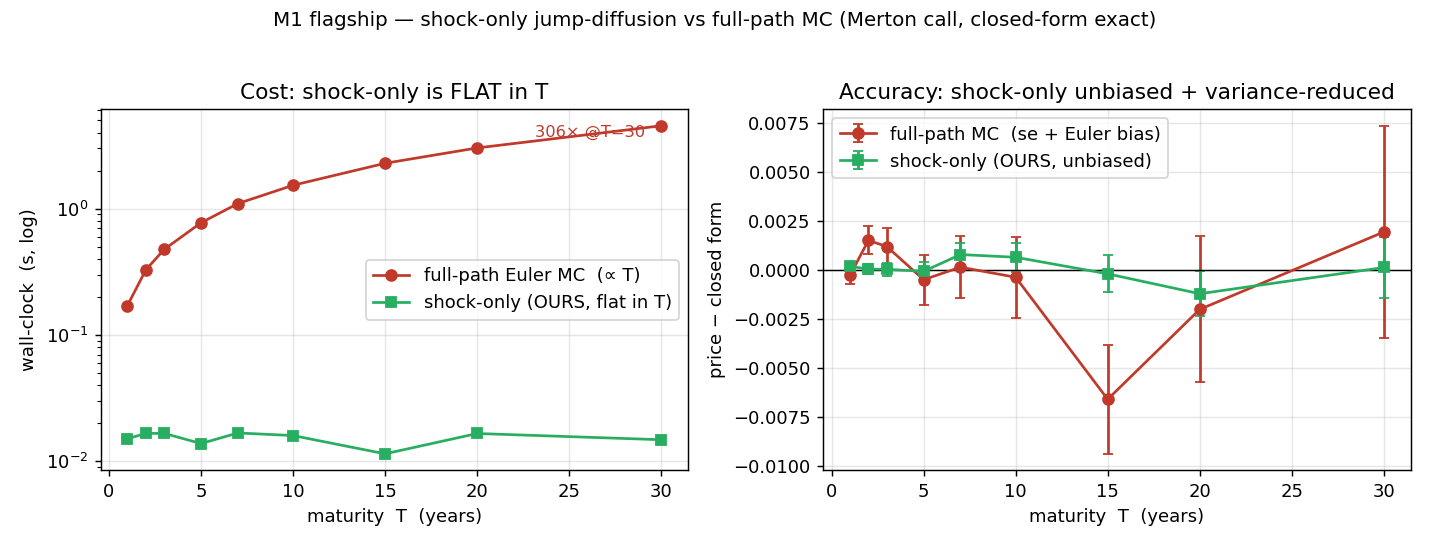
The solved operator is projected to a small subspace where any horizon is a small-matrix computation: applying thirty years costs the same as applying one day, and a whole maturity surface comes from one build.
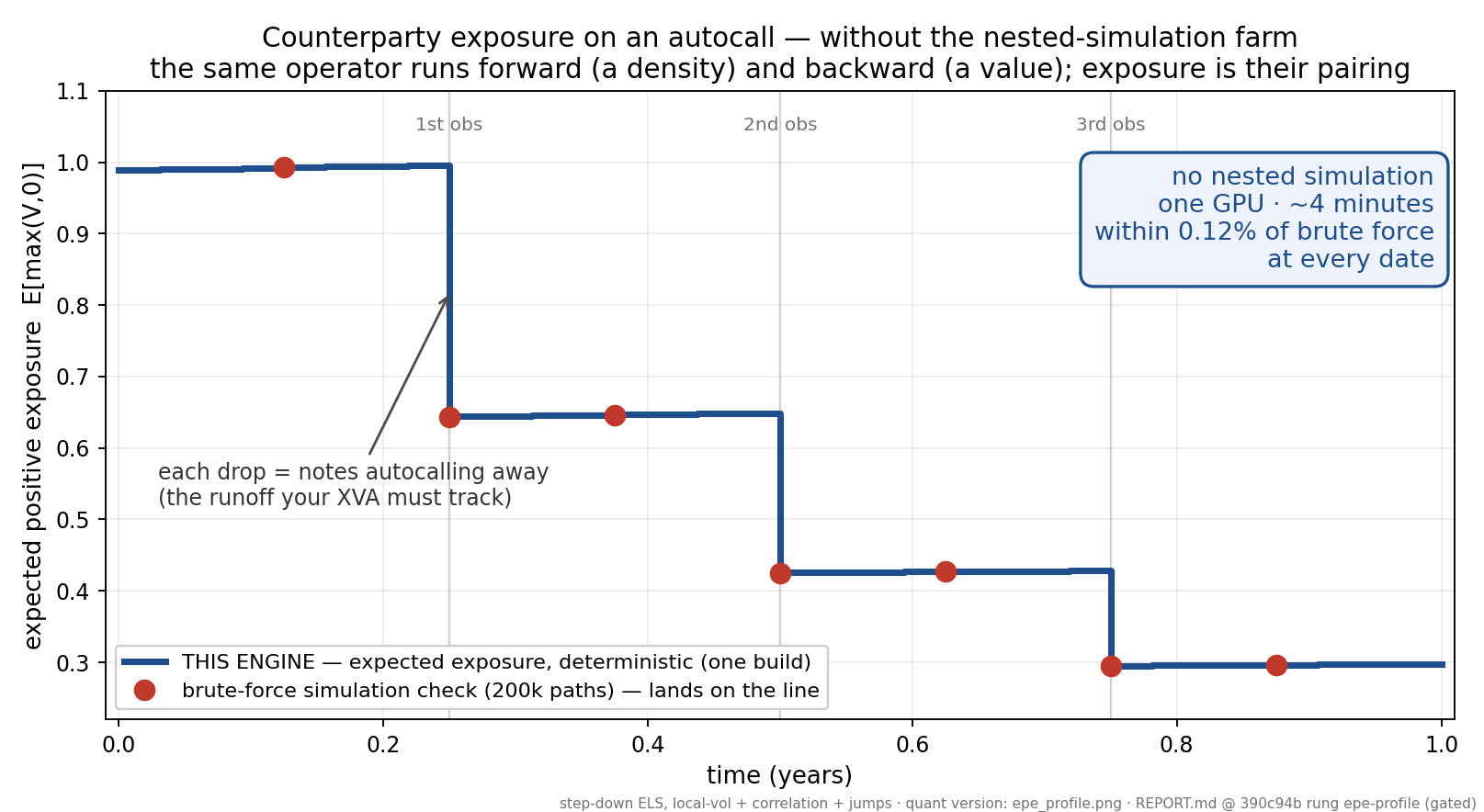
Autocall dates, memory coupons, and discrete knock-ins apply between marches as exact projections — discrete monitoring priced with no continuity correction. Run the same operator in reverse and it produces counterparty-exposure profiles with no nested simulation.
Every number here regenerates from a provenance-stamped, gated benchmark: one command rebuilds the full evidence base, a numeric pass gate lives inside each benchmark, and a regression flips the report on its own. The comparisons run against closed forms, QuantLib, and 10M-path Monte-Carlo anchors — nulls published as prominently as the wins.
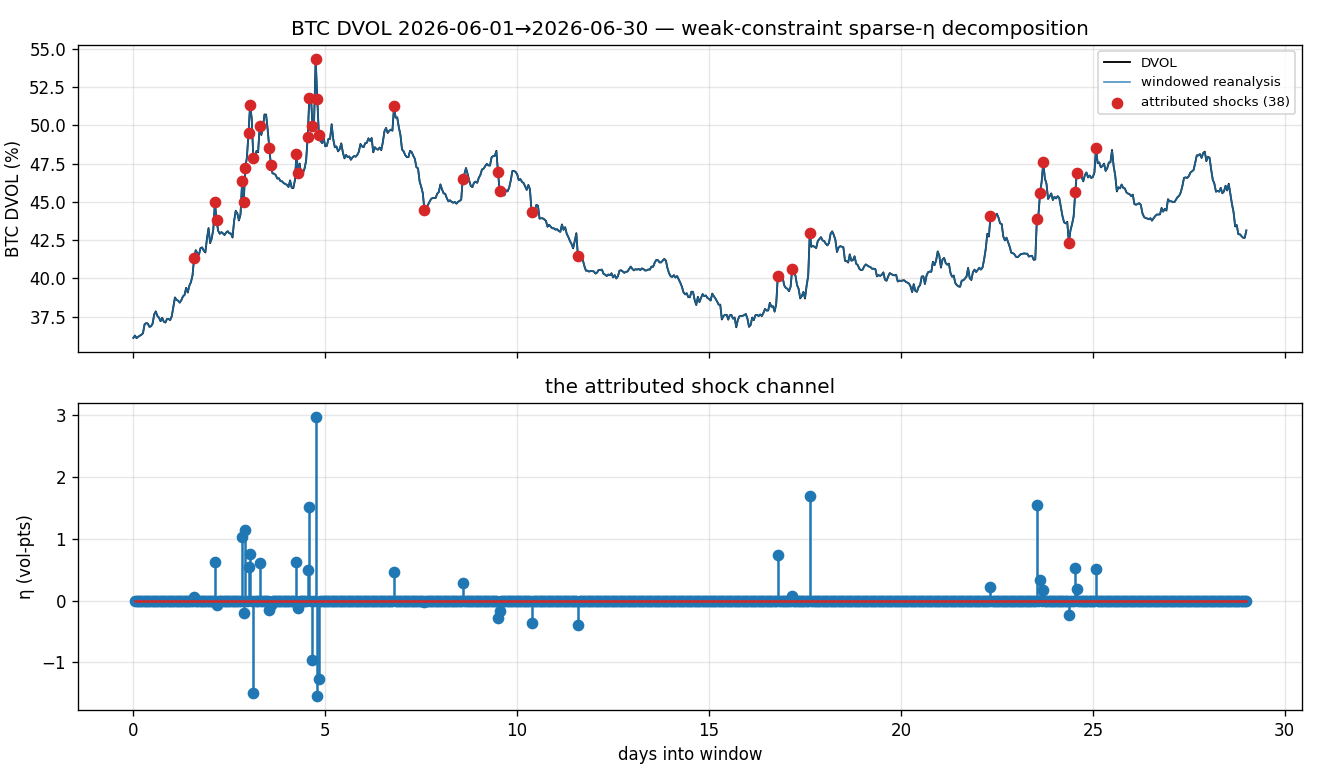
Because the value flow of the pricing model is a linear semigroup, streaming quotes can be assimilated into the model’s coefficients continuously, with calibrated uncertainty ��� and every innovation decomposed into noise, drift, or an attributed shock. Validated on live exchange options: exactly silent through quiet weeks, 38 named and sized events through a real volatility episode. Every commercial surface product either fits snapshots or reprices fast; none tracks a model-consistent trajectory, carries calibrated uncertainty, or attributes its misfit.
Scope claims here stay inside what the gates actually certify. If your book lives outside this list, we tell you before a pilot, not during one.
Built for the group that has to approve it. A 15/15 gated benchmark ladder runs against independent referees — QuantLib and Monte-Carlo with common-random-number controls — and a 158-test gate suite ships with the distribution, running on the exact binaries we deliver. Certified on enterprise GPU hardware, with published null results and a written scope-and-limitations statement. Claims about a pricing method should be cheap to check and expensive to fake.
| Claim | Reference | Result |
|---|---|---|
| Real step-down term sheet (memory, discrete KI) | identical-logic Monte-Carlo | within MC noise (±0.02%) |
| Correlation risk through the breach | matched-seed MC bump | 4.78 vs 4.68 ± 0.17 |
| 2-asset worst-of | Stulz (1982) closed form | 10⁻⁸ |
| Whole implied-vol surface to 30y | Richardson-extrapolated fine CN | 0.006 bp mean · 1.6 s |
| Counterparty exposure profile | brute-force nested simulation | ≤ 0.12% at every date |
| Bermudan exercise | QuantLib finite differences | < 0.5% |
| vs Craig–Sneyd ADI / sparse CN, same grid | Stulz closed form | ~230× (price and corr. risk) |
Published nulls, for the avoidance of doubt: in 1D on raw payoffs, tridiagonal Crank–Nicolson wins wall-clock at equal accuracy; and simulation deltas are fine — we do not sell better deltas. The value is in the numbers simulation cannot read.
For model-risk teams: SR 11-7-style vendor-model documentation ��� full whitepaper, gate inventory, and a written model scope-and-limitations statement — is available under NDA for independent validation. The falsification program is designed so your MRM team can rerun the evidence on the delivered binaries, not just read it.
Your positions and market data never leave your infrastructure. There is no vendor cloud, and nothing about an evaluation requires you to send us a book.
I’m Andrew. I built Krylo — the numerical methods, the gates, and the distribution. I’m completing a PhD in applied mathematics at BYU (Phi Kappa Phi), I hold two patents as named inventor, and I spent four years as a data scientist in industrial R&D building diagnostic medical technology. You deal with one person, and the accountability is undivided.
Fixed fee · week-two review · either side stops.